Blog · Provenance & cataloguing
Art provenance and the catalogue raisonné: how a work’s history survives
How museum provenance punctuation, nineteenth-century dealer stock books and catalogues raisonnés establish where an object has been and which transfers remain unproved.
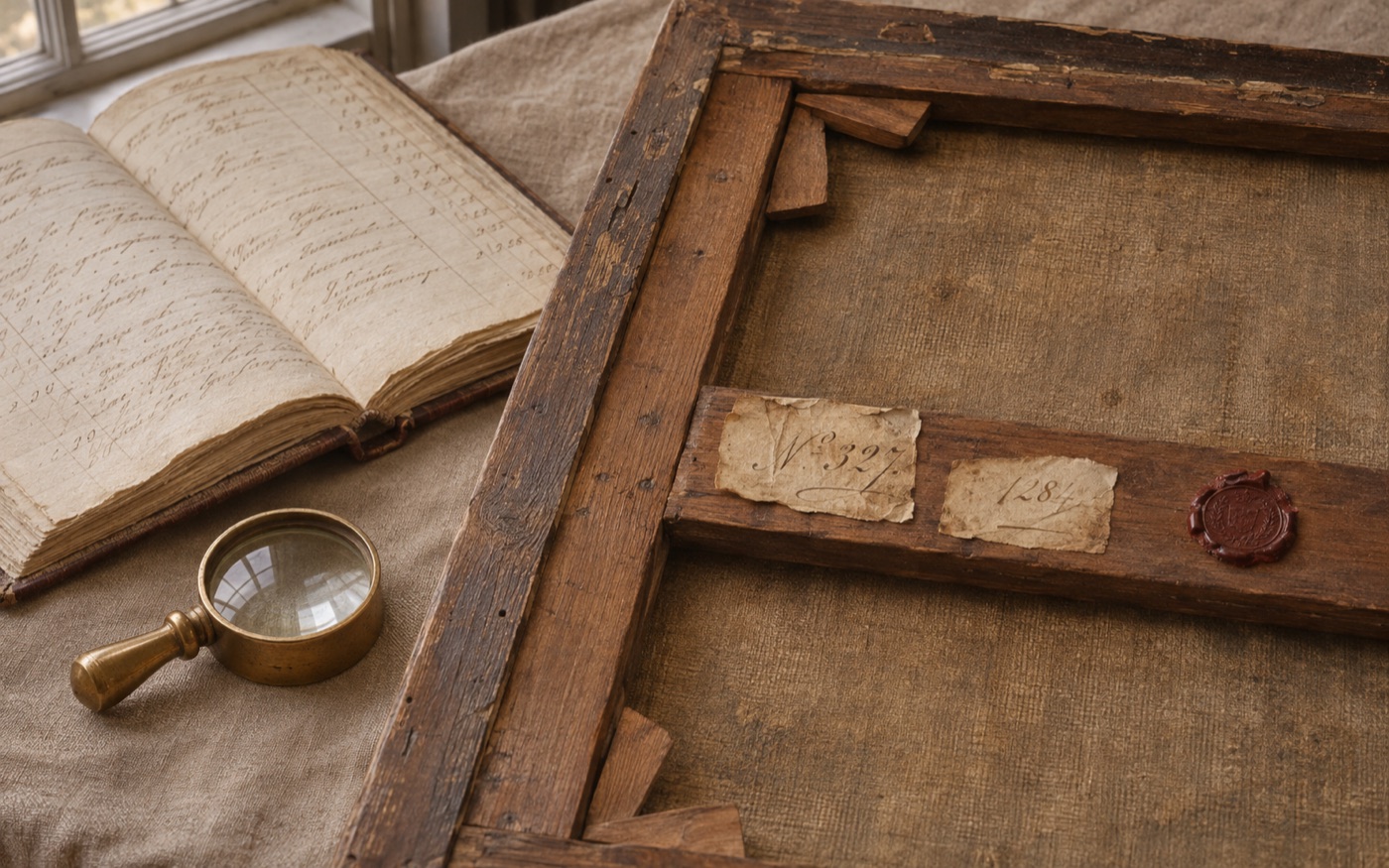
Turn an older easel painting to the wall and its commercial biography frequently comes into view before a single archive is opened. Gummed paper labels from Bond Street or Fifth Avenue rooms, blue-crayon customs marks, red wax seals pressed onto a crossbar, and stencilled auction house stock numbers sit across the oak stretcher or cradled panel. In art history and market research, art provenance (from the French provenir, to come forth) is the chronological record of those custodians: every studio, dealer, saleroom, private collector and public institution through whose hands a specific object has passed since it left its maker.
Where provenance tracks custody across time, a catalogue raisonné anchors identity across an artist’s entire output. The two instruments depend upon one another. A chain of invoices means little if two nearly identical studio variants have been confused in nineteenth-century sale catalogues; equally, an attribution rests on thinner ground when sixty years of ownership between studio and saleroom cannot be accounted for. Reading our sales library alongside museum registers shows how those two forms of proof reinforce each other in practice.
What provenance in art actually proves
Popular summaries often treat provenance as a certificate of authenticity. Archival researchers read it more narrowly and more usefully. A documented ownership line does not by itself prove that a hand painted a panel, yet it establishes three concrete facts that connoisseurship and technical imaging cannot supply alone.
First, it narrows historical possibility: if an inventory places a specific portrait in a Venetian palazzo in 1620, later nineteenth-century pastiche is ruled out. Second, it tests legal title and wartime spoliation history, particularly for works that crossed continental Europe between 1933 and 1945 or left archaeological sites after international conventions took effect. Third, it distinguishes separate transactions that press accounts routinely collapse into one.
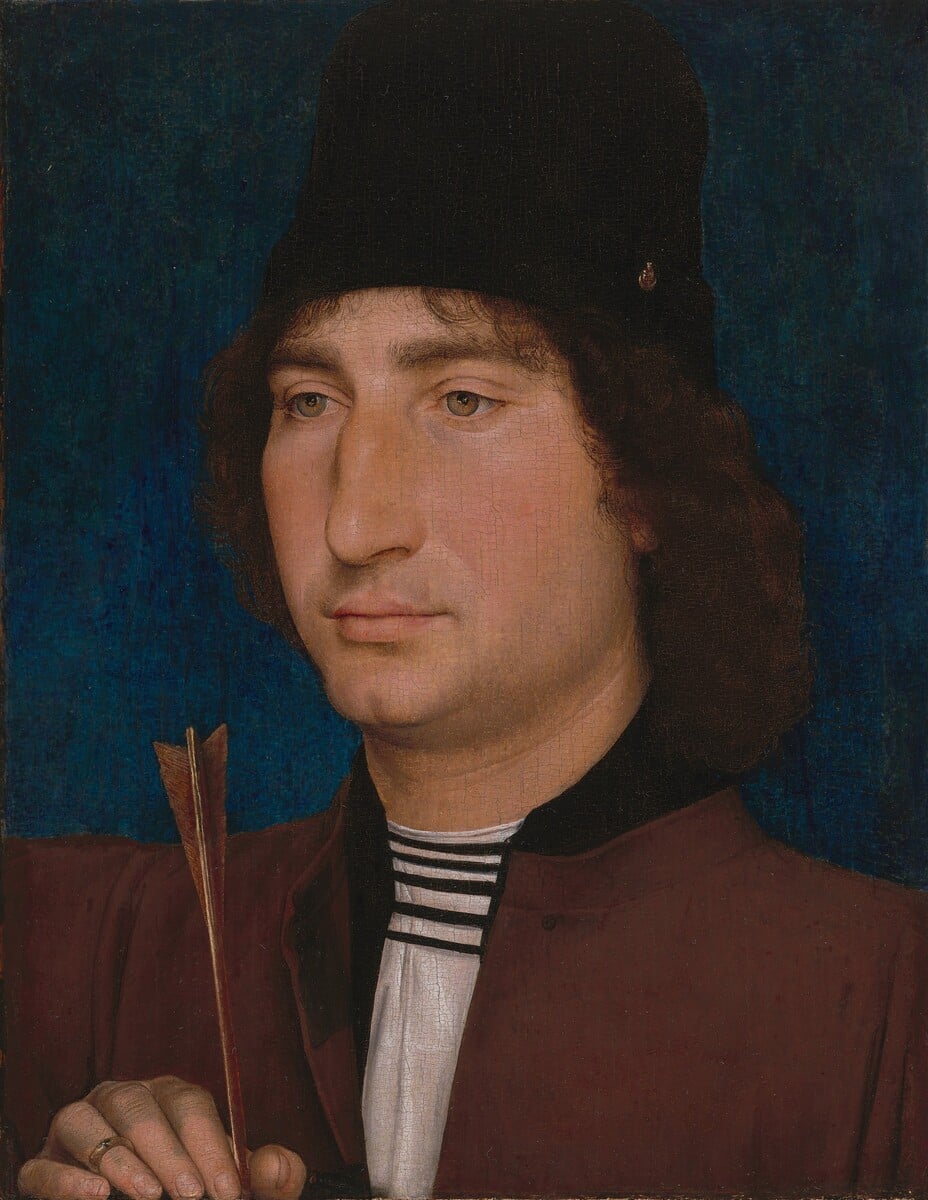
Kleinberger and Co. · 5 January 1916
Portrait of a Man with an Arrow
Hans Memling · Image courtesy of the National Gallery of Art, Washington · Public domain · Image source ↗
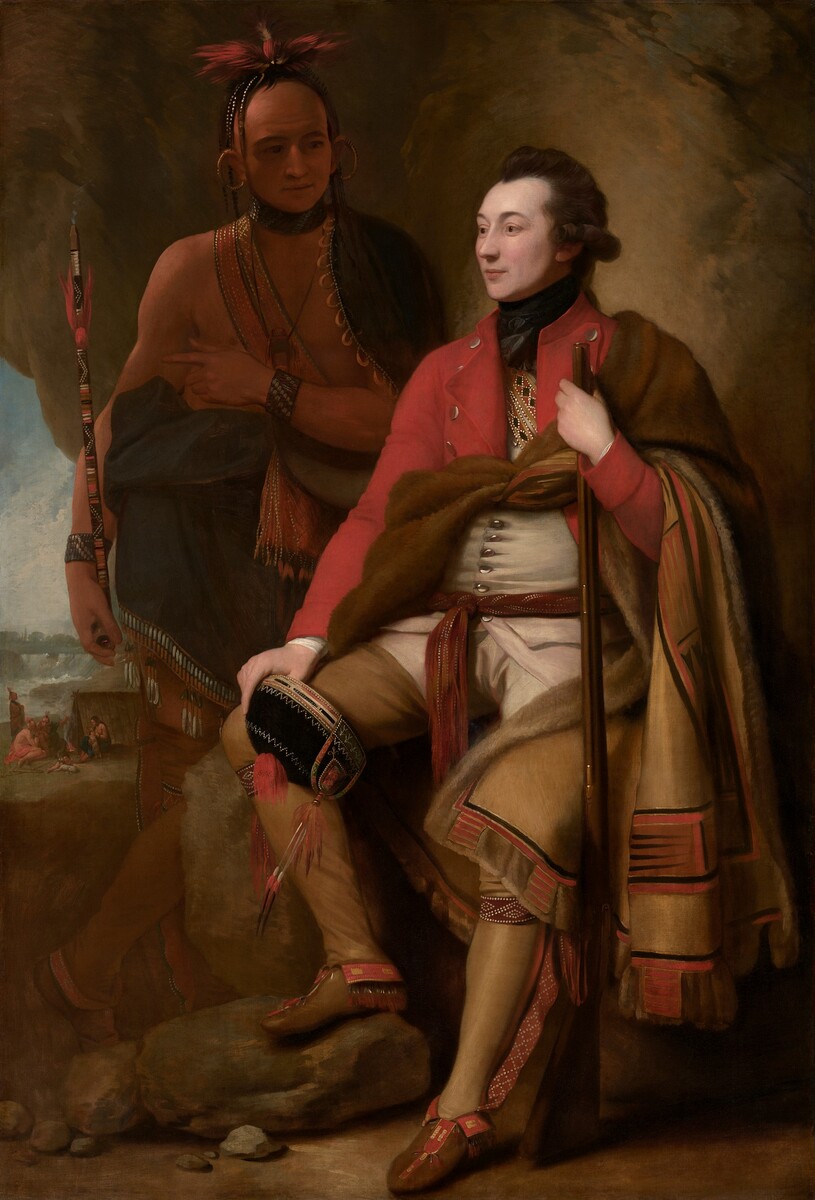
M. Knoedler & Co. · 21 January 1937
Colonel Guy Johnson and Karonghyontye (Captain David Hill)
Benjamin West · Image courtesy of the National Gallery of Art, Washington · Public domain · Image source ↗
Consider two paintings now hanging in the National Gallery of Art in Washington, each preserved in our United States sales register. On 5 January 1916, the New York and Paris firm Kleinberger and Co. sold Hans Memling’s fifteenth-century panel Portrait of a Man with an Arrow to the collector Michael Dreicer. Twenty-one years later, on 21 January 1937, M. Knoedler & Co. in New York sold Benjamin West’s 1776 double portrait Colonel Guy Johnson and Karonghyontye (Captain David Hill) to Andrew W. Mellon’s trust; the trust’s subsequent gift to the nation in 1940 constituted a distinct legal transfer. Because both Knoedler’s and Kleinberger’s business papers survive in research repositories, museum cataloguers can cite the exact January day on which title moved from dealer stock to collector, rather than compressing half a century into “acquired before 1940”.
Reading the punctuation of a provenance entry
Museum provenance paragraphs look terse because their punctuation is doing technical work. Since the late twentieth century, major Anglo-American and European institutions have converged on a shared typographical grammar so that a reader can tell at a glance where documentary proof holds and where it breaks off.
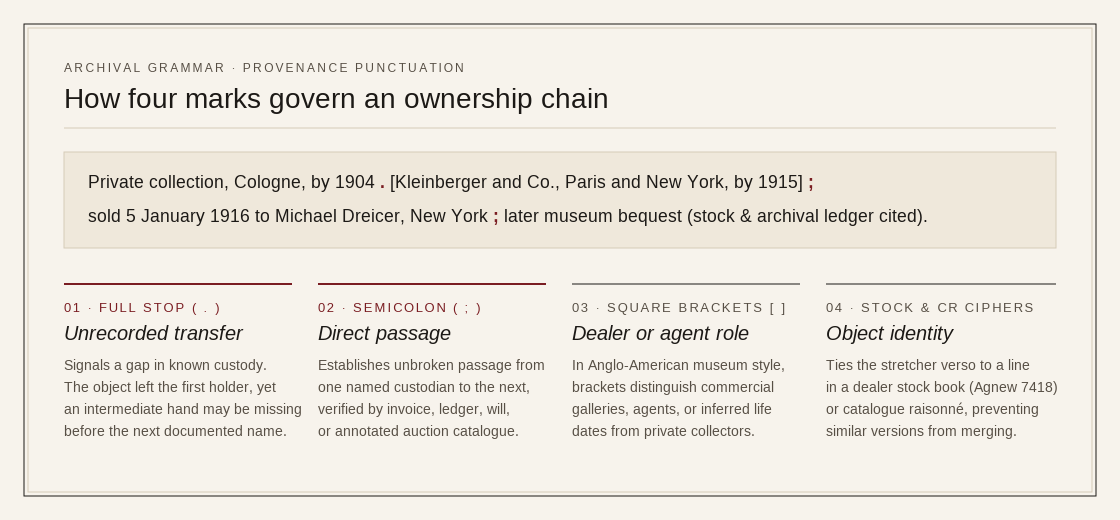
When reading an art provenance example in a museum catalogue or evening-sale footnote, four conventions carry the weight:
| Mark or element | Meaning in archival practice | Documentary basis |
|---|---|---|
Semicolon (;) | Direct transfer with no missing custodian between the two named parties. | Bill of sale, receipt, estate inventory, or deed of gift naming both sides. |
Full stop (.) | Gap in documented custody; the object left the first owner, but how it reached the next named holder is unrecorded. | Separate dated references (such as two exhibition loans decades apart) without linking invoices. |
Square brackets ([ ]) | Identifies a commercial dealer, auction agent or gallery acting as intermediary, or encloses inferred dates and locations. | Dealer stock books, consignment ledgers, or annotated auctioneer copies. |
| Qualifying prepositions | “By 1912” marks the latest date an owner held the work; “until at least 1936” marks the last confirmed sighting before a silence. | Exhibition checklists, insurance schedules, or published collection reviews. |
That distinction between a semicolon and a full stop governed one of the sharpest price adjustments in our November 2026 issue. When Max Oppenheimer’s 1914 canvas Das Hess-Quartett. Streichquartett I appeared at Dorotheum in Vienna on 17 November 2026, its exhibition history paused in 1936, followed by ninety years out of public view, yet its private custody and restitution history were documented clearly enough for international bidding to carry the work from a €500,000 upper estimate to €3,550,000 with premium and VAT. Scarcity only commands confidence when the custody chain holds.
What is a catalogue raisonné, and how does it differ?
A catalogue raisonné (French for “reasoned catalogue”) is the scholarly, systematic inventory of every known work by an artist, either across their full career or within a defined medium such as prints, sculpture or works on paper. Where an exhibition catalogue records what hung in one building during one season, a catalogue raisonné aims for completeness: every accepted work receives a permanent reference number, physical dimensions, medium and support, inscription transcriptions, exhibition history, bibliography, reproduction plate, and provenance up to the date of publication.
For nineteenth- and twentieth-century artists who painted recurring motifs (Claude Monet along the Normandy cliffs, René Magritte returning across oils and gouaches to L’empire des lumières, or Josef Albers working through nested squares), the catalogue raisonné prevents what archivists call conflation: accidentally attaching the 1924 Paris auction record of one canvas to a near-twin of identical dimensions painted the same summer. Increasingly, artist foundations maintain living digital catalogues raisonnés that amend provenance lines as historic gallery archives are digitised.
How dealer stock books bridge the nineteenth and twentieth centuries
Between the dispersal of aristocratic European collections after 1880 and the rise of modern public museums, a small group of transatlantic dealerships (Thomas Agnew & Sons in London, M. Knoedler & Co., Duveen Brothers, Kleinberger, Paul Rosenberg and Bernheim-Jeune) acted as the primary clearing houses for old masters and modern painting. When a collector bought privately rather than in a public saleroom, no auction catalogue existed. Only the dealer’s internal stock book preserved the link.
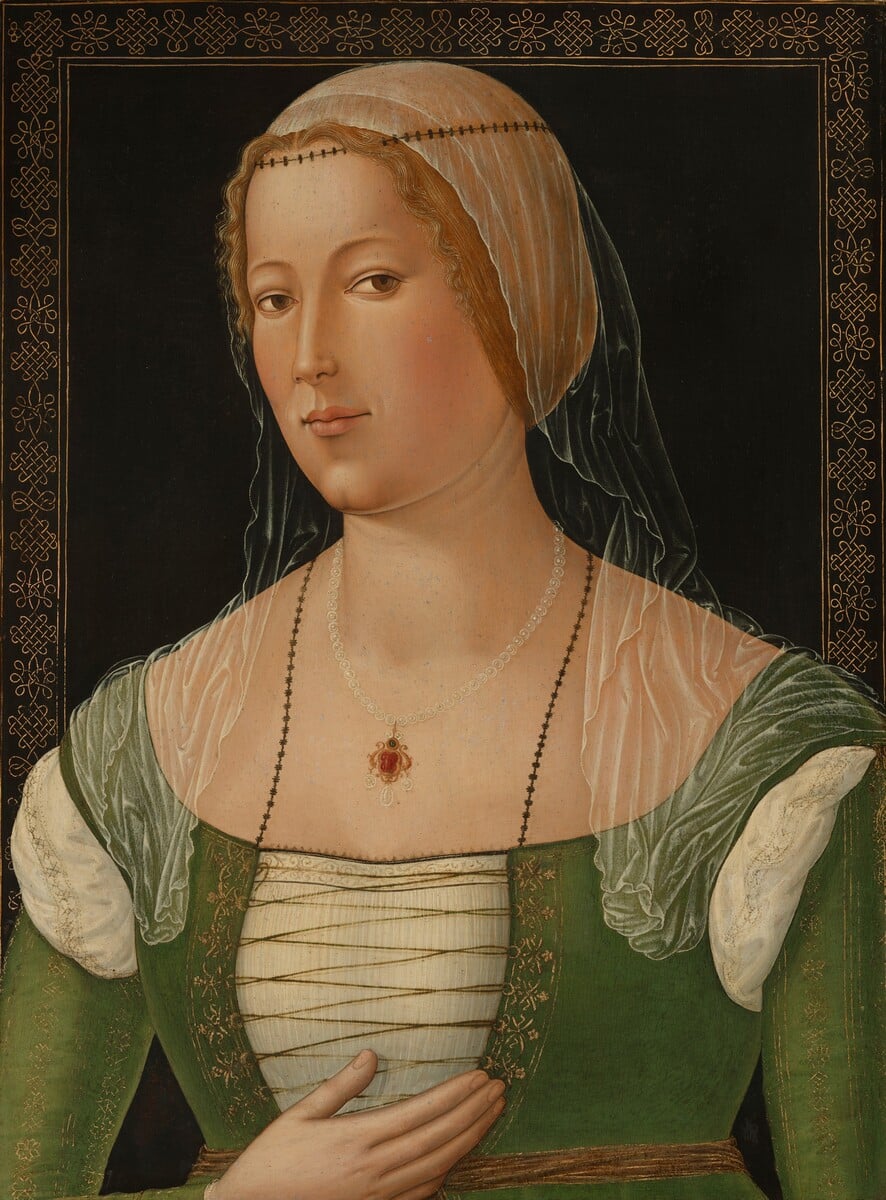
Gallery sale · United Kingdom
Agnew’s London stock number 7418 ties Girolamo di Benvenuto’s early sixteenth-century panel directly to the firm’s purchase and onward sale in November 1895.
Girolamo di Benvenuto · Image courtesy of the National Gallery of Art, Washington · Public domain · Image source ↗ · Permanent record →
Girolamo di Benvenuto’s Sienese panel Portrait of a Young Woman illustrates why those stock numbers remain decisive more than a century later. In our United Kingdom register, the portrait’s November 1895 crossing through Thomas Agnew & Sons rests on Agnew’s stock cipher 7418, preserved in the firm’s ledgers (now held by the National Gallery Archive in London) and cited by the National Gallery of Art in Washington. Whenever a stretcher or panel verso still bears a four- or five-digit stock stencil, a researcher can match that cipher against microfilmed stock books at the Getty Research Institute, the Frick Art Reference Library or the Rijksbureau voor Kunsthistorische Documentatie (RKD) in The Hague to recover the consignor, buyer, and exact month of sale.
“A price tells us what two parties agreed on a Tuesday afternoon; a stock cipher and a semicolon tell us how the object crossed the century intact.”
How contemporary sales become tomorrow’s provenance
Provenance does not begin when a painting turns a hundred years old; it begins on the day a work first leaves the studio or fair stand. Yet contemporary transactions frequently enter the record with thinner documentation than an 1895 Bond Street ledger. Edition numbers on photographs and bronzes go unnamed in fair round-ups; online viewing rooms disappear weeks after an exhibition closes; and private sales settle behind non-disclosure clauses.
That fragility explains the inclusion rules set out on our editorial standards page. Every entry in deployed.works names the selling gallery, auction house or acquiring museum, preserves the exact sentence from the primary source that establishes the transfer, and leaves open what the source leaves open, whether an unrecorded edition number on a contemporary print in Miami or an unpublished invoice at a Paris fair. Galleries and exhibiting artists who wish to anchor a contemporary transfer in the permanent index can file primary documentation directly through our sale submission desk.
Records cited from the library
Every transaction discussed above keeps a permanent source-verified entry in the deployed.works register.
Kleinberger and Co.
5 January 1916 · United States
Price unpublished
Colonel Guy Johnson and Karonghyontye (Captain David Hill)
Dealer sale recorded in museum provenance
M. Knoedler & Co.
21 January 1937 · United States
Price unpublished
Thomas Agnew & Sons
November 1895 · United Kingdom
Price unpublished
Das Hess-Quartett. Streichquartett I (The Hess Quartet. String Quartet I)
Oil on canvas, 120 × 117 cm; 1914
Dorotheum
17 November 2026 · Austria
EUR 3,550,000
Further reading in the blog

Institutional custody · 25 November 2026 · 7 min read
Museum accession numbers and credit lines: how art leaves the market
Every wall label in a public gallery carries a short numerical cipher and a credit line. Decoded properly, those two lines record when a work stepped out of commerce and who paid for its crossing.
Saleroom & fair mechanics · 24 November 2026 · 7 min read
Hammer price, buyer’s premium and the gallery asking price
Why two truthful reports of the same sale can print two different sums, and how auction fees, reserves and fair checklists govern what the public actually learns.