Blog · Saleroom & fair mechanics
Hammer price, buyer’s premium and the gallery asking price
Why two truthful reports of the same sale can print two different sums, and how auction fees, reserves and fair checklists govern what the public actually learns.
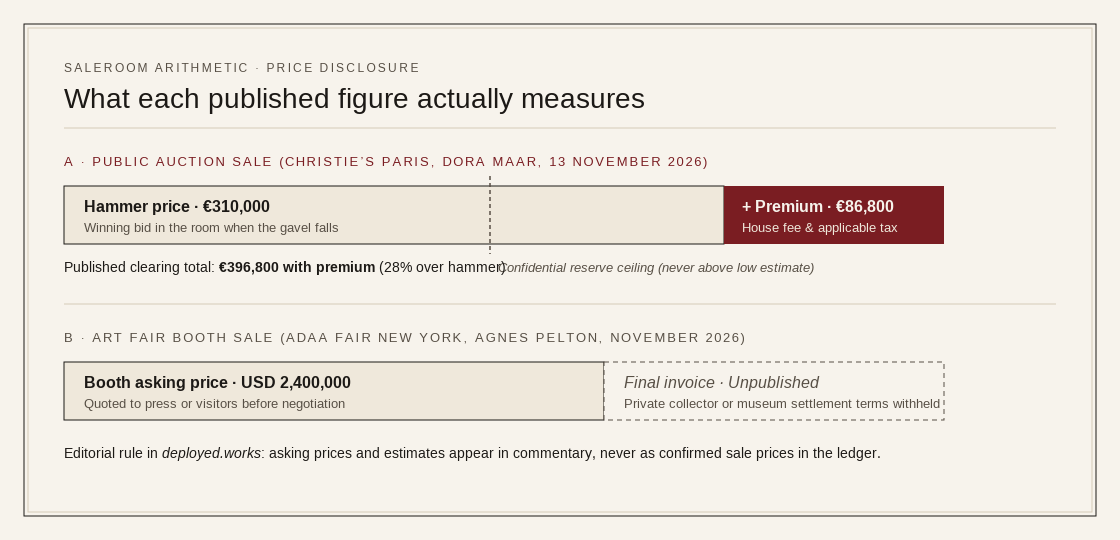
Anyone comparing art auction results across newspapers, trade databases and saleroom press releases soon meets an arithmetic discrepancy. One account reports that a photograph sold in Paris for €310,000; another records the identical lot from the same Friday evening at €396,800. Neither writer has misread the room. The first cited the hammer price; the second cited the clearing figure including buyer’s premium.
Confusing those two numbers, or treating an art fair booth’s opening asking price as a settled invoice, distorts historical comparisons by twenty to thirty per cent at a stroke. Reading documented art sales accurately requires separating four distinct mechanisms: the pre-sale estimate, the confidential reserve, the hammer price, and the post-hammer fee schedule, before contrasting all four with how private galleries disclose sales on the fairground.
What is hammer price, and what is a buyer’s premium?
In a public auction, the hammer price is the final bid called from the rostrum at the instant the auctioneer brings down the gavel. It measures the gross figure at which competition in the room, on the telephones and online came to rest: one increment above the underbidder’s last offer. Crucially, pre-sale printed low and high estimates are always quoted on a hammer basis, excluding fees.
The buyer’s premium is the surcharge added to that winning bid by the auction house and paid by the buyer as part of the final settlement. Introduced widely across international salerooms in the mid-1970s and structured today on a sliding, regressive scale, the buyer’s premium funds the house’s cataloguing, marketing and operational margin alongside (or in place of) the seller’s commission.
Across international houses such as Christie’s, Sotheby’s, Phillips, Bonhams and Dorotheum, the premium follows tiered brackets set out in the conditions of sale at the back of every catalogue:
| Typical hammer tier | Representative premium rate | Effect on published price |
|---|---|---|
| Up to ~$/£/€1,000,000 | 25% – 28% of hammer | A €310,000 hammer bid becomes €396,800 with a 28% premium before local levies. |
| Mid-tier (~$1,000,000 to $6,000,000) | 20% – 22% on the slice above the first threshold | Blended fee percentage steps down gradually as the lot crosses each bracket. |
| Upper tier (above ~$6,000,000) | 14% – 15% on the excess | Even on nine-figure evening lots, fees add tens of millions to the hammer bid. |
| Artist’s Resale Right (droit de suite) & VAT | Statutory percentage in UK/EU jurisdictions | Applied to qualifying works by living or recently deceased artists (within 70 years of death). |
When René Magritte’s 1954 oil L’empire des lumières cleared at Christie’s New York on 19 November 2024 for USD 121,160,000, that headline sum combined a nine-figure hammer bid with eight figures of tiered buyer’s premium. Both numbers are real: the hammer price records where the two final bidders stopped; the premium-inclusive figure records what the buyer wired to take title.
Why estimates must be compared against the hammer, never the invoice
The sharpest misreadings occur when a casual report compares a premium-inclusive sale result directly against a hammer-only pre-sale estimate. Consider two lots offered minutes apart at Christie’s Paris during the dispersal of the Roger Therond photography collection on 13 November 2026, both analysed in Issue No. 1.
Dora Maar’s circa-1935 Surrealist montage Sans titre (Mannequin-Étoile) hammered at €310,000 and settled at €396,800 with fees, establishing an auction benchmark for the artist. Later in the same session, Gustave Le Gray’s 1867–68 album of fifty albumen prints made in Upper Egypt hammered at €600,000 and reached €768,000 with buyer’s premium. Measured solely by invoice size, the Le Gray album fetched nearly twice as much as the Maar montage. Yet Le Gray’s album had entered the evening with a low estimate of €800,000 before fees. Even with €168,000 of premium added, the total sat below the low estimate, meaning the consignor agreed to lower the confidential reserve (the unpublished minimum price below which an auctioneer will not knock a lot down, legally capped at or below the low estimate) so that the album could sell on the night rather than go bought in (unsold).
Art fair sales: the asking price and the red dot
Step out of the auction saleroom onto the carpet of Art Basel, Frieze, the ADAA Fair or Art Toronto and statutory public bidding gives way to private contract. A commercial gallery owes no public accounting of its invoices. Consequently, art fair sales enter the published record through three distinct, partial channels, each carrying its own evidentiary boundary.
First is the confirmed settlement report, where a gallery states both that a work sold and the price at which it placed: for example, Waddington Custot’s sale of Jean Dubuffet’s Le malentendu 23 décembre 1976 at Frieze Masters in London at GBP 950,000, or Karma’s placement of Gertrude Abercrombie’s 1953 Little Silo at USD 350,000.
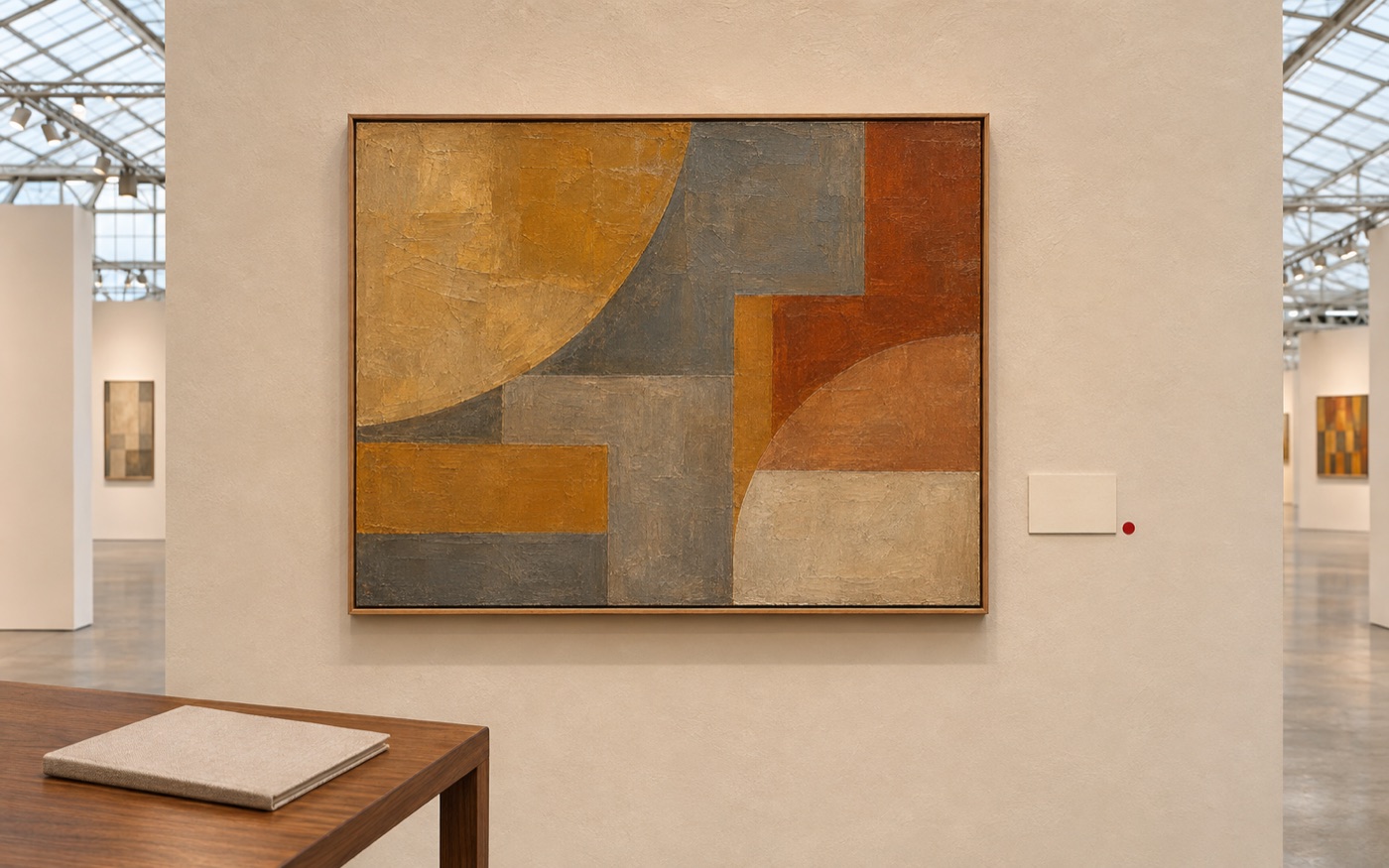
Second is the asking-price report. At the ADAA Fair at the Park Avenue Armory in November 2026, Jonathan Boos sold Agnes Pelton’s 1932 painting The Well of Peace; press coverage named the booth’s USD 2,400,000 asking price while leaving the agreed invoice unstated. Standard trade practice frequently extends a ten-to-fifteen per cent courtesy discount to museums or longstanding private clients, or structures payment across instalments. Treating an asking price as a realised price invents precision that the document does not support.
Third is the unpriced sold checklist. At Art Toronto, Roberts Gallery left its online exhibition checklist public with explicit sold markers across seventeen Canadian works, ranging from historical works on paper by Arthur Lismer and Carl Schaefer to three 2026 oils by Bewabon Shilling, without publishing a single figure. Similarly, when a fair press note bundles two works under one number (as happened at Paris Photo when a report linked “$35,000” to two prints by Ahmet Ertuğ without stating whether the sum applied to each print or the pair), a rigorous archive leaves the price field blank and records the ambiguity in prose.
Private treaty and historical dealer sales
Private non-disclosure is not a contemporary invention. Throughout the nineteenth and twentieth centuries, the highest-value old master and eighteenth-century British portraits routinely bypassed the auction rostrum altogether through private treaty sales negotiated in London, Paris or New York viewing rooms.
Gallery sale · United States
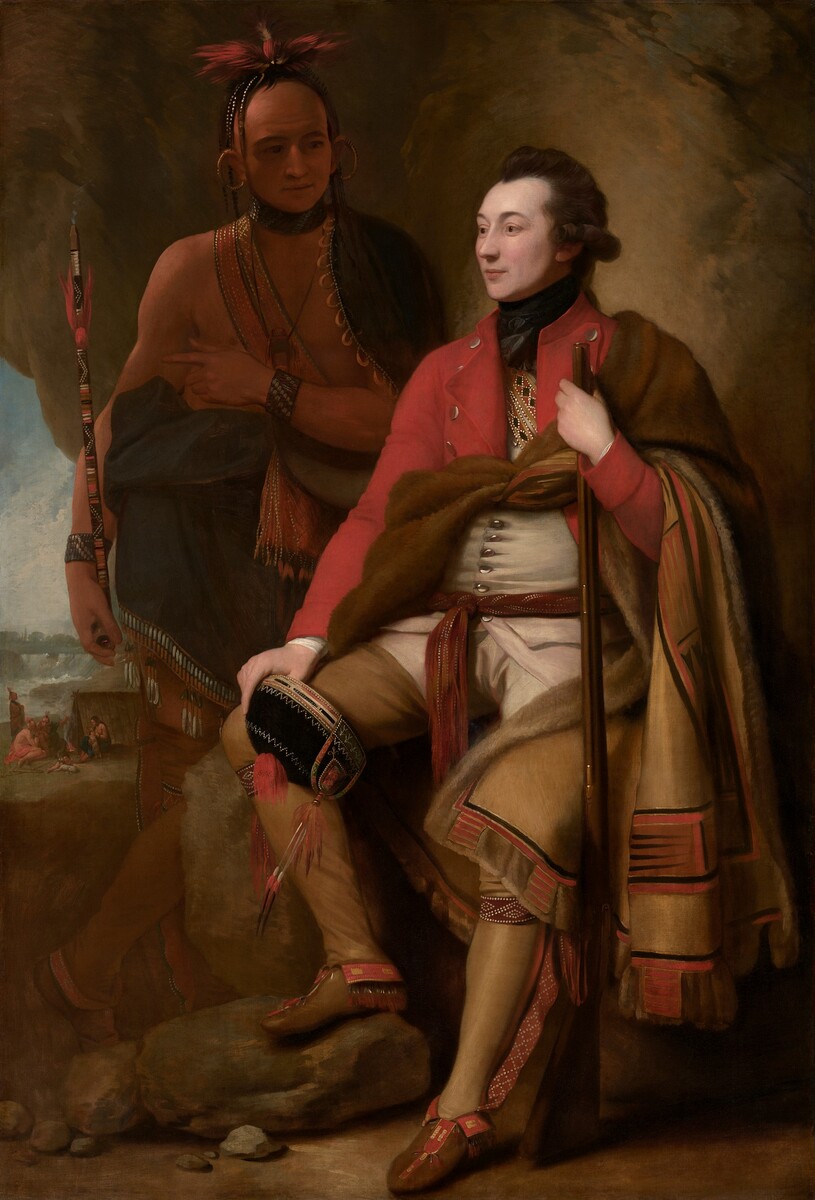
Colonel Guy Johnson and Karonghyontye (Captain David Hill)
Sold privately by M. Knoedler & Co. in New York on 21 January 1937 to Andrew W. Mellon’s educational and charitable trust: museum provenance establishes the exact date and parties while leaving the private contract sum outside the gallery wall label.
Benjamin West · Image courtesy of the National Gallery of Art, Washington · Public domain · Image source ↗ · Permanent record →
When M. Knoedler & Co. sold Benjamin West’s Colonel Guy Johnson and Karonghyontye (Captain David Hill) on 21 January 1937, no paddle rose in a public room and no newspaper printed a clearing figure the next morning. Decades later, museum provenance research and opened dealer ledgers give us a cleaner record of the transfer date and buyer than many contemporary fair booths provide, even where the invoice remains archival rather than public.
“Silence in a price column is not missing research; it is an exact description of what the primary document chose to disclose.”
Whether a work clears under an auctioneer’s gavel in Hong Kong, leaves a stand in Basel, or sells directly from an artist’s shop in our creator sales section, the reader consulting the archive ten years hence needs the same clarity: who sold the work, what document proves it changed hands, and whether a quoted sum represents hammer, premium, asking bracket, or confirmed invoice. Explore the full machine-readable dataset at any time through our sales library.
Records cited from the library
Every transaction discussed above keeps a permanent source-verified entry in the deployed.works register.
Sans titre (Mannequin-Étoile)
Gelatin silver print mounted on card, image 29.7 × 16.9 cm; circa 1935
Christie’s Paris
13 November 2026 · France
EUR 396,800
Voyage dans la Haute-Egypte pour les Altesses, les Princes héréditaires fils de S.A. Ismaïl Pacha, Vice-Roi d’Égypte
Album of 50 albumen prints; 1867–1868 (as described by L’Art de la photo)
Christie’s Paris
13 November 2026 · France
EUR 768,000
Das Hess-Quartett. Streichquartett I (The Hess Quartet. String Quartet I)
Oil on canvas, 120 × 117 cm; 1914
Dorotheum
17 November 2026 · Austria
EUR 3,550,000
Christie’s
19 November 2024 · United States
USD 121,160,000
Jonathan Boos
12–16 November 2026 · United States
Price unpublished
Colonel Guy Johnson and Karonghyontye (Captain David Hill)
Dealer sale recorded in museum provenance
M. Knoedler & Co.
21 January 1937 · United States
Price unpublished
Further reading in the blog

Institutional custody · 25 November 2026 · 7 min read
Museum accession numbers and credit lines: how art leaves the market
Every wall label in a public gallery carries a short numerical cipher and a credit line. Decoded properly, those two lines record when a work stepped out of commerce and who paid for its crossing.
Provenance & cataloguing · 23 November 2026 · 7 min read
Art provenance and the catalogue raisonné: how a work’s history survives
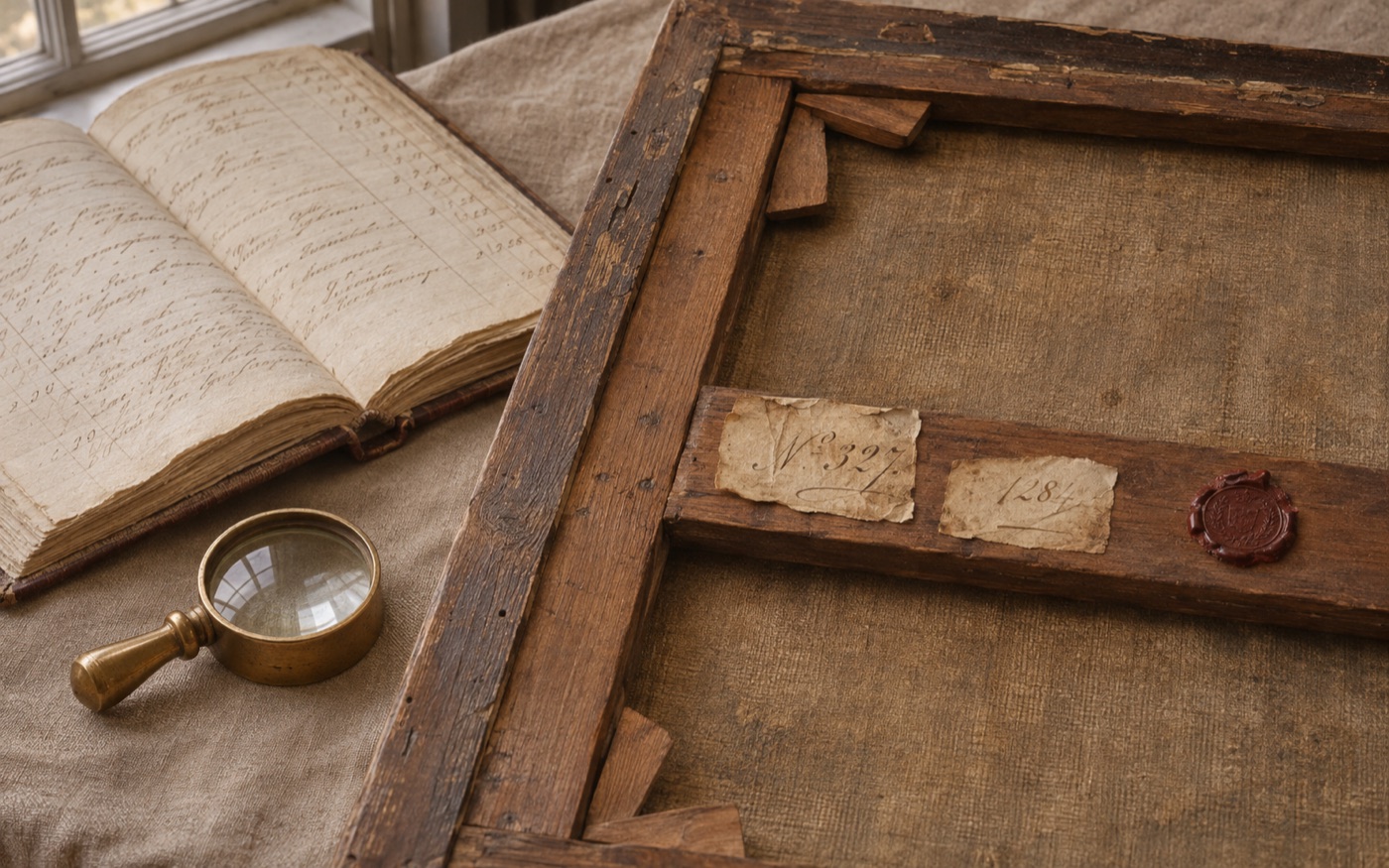
How museum provenance punctuation, nineteenth-century dealer stock books and catalogues raisonnés establish where an object has been and which transfers remain unproved.