Blog · Institutional custody
Museum accession numbers and credit lines: how art leaves the market
Every wall label in a public gallery carries a short numerical cipher and a credit line. Decoded properly, those two lines record when a work stepped out of commerce and who paid for its crossing.

At the foot of almost every museum wall label, beneath the artist’s dates, title, medium and dimensions, sit a single sentence of acknowledgement and a string of digits separated by full stops: 31.45 or 1993.132 or 1942.9.91. Most gallery visitors read past them on their way to the curator’s commentary. Yet for anyone studying how art changes hands, that museum accession number and its accompanying credit line form the most durable transaction record in the visual arts.
Unlike an auction invoice or a dealer’s fair checklist, a museum registration entry marks an exit from the commercial market. Understanding how registrars construct accession numbers, how purchase funds differ from gifts and bequests, and why museums rarely reverse the process reveals the quiet institutional terminus toward which centuries of private collecting eventually lead.
Accession number meaning: how registrars build the cipher
In museum practice, acquisition is the legal transfer of title (by purchase, gift, bequest, exchange or field expedition), whereas accessioning is the formal administrative act by which a museum’s governing board accepts that object into the permanent public trust and records it in the institution’s register. The museum accession number assigned at that moment gives the object a unique, permanent identifier independent of shifting attributions or descriptive titles.
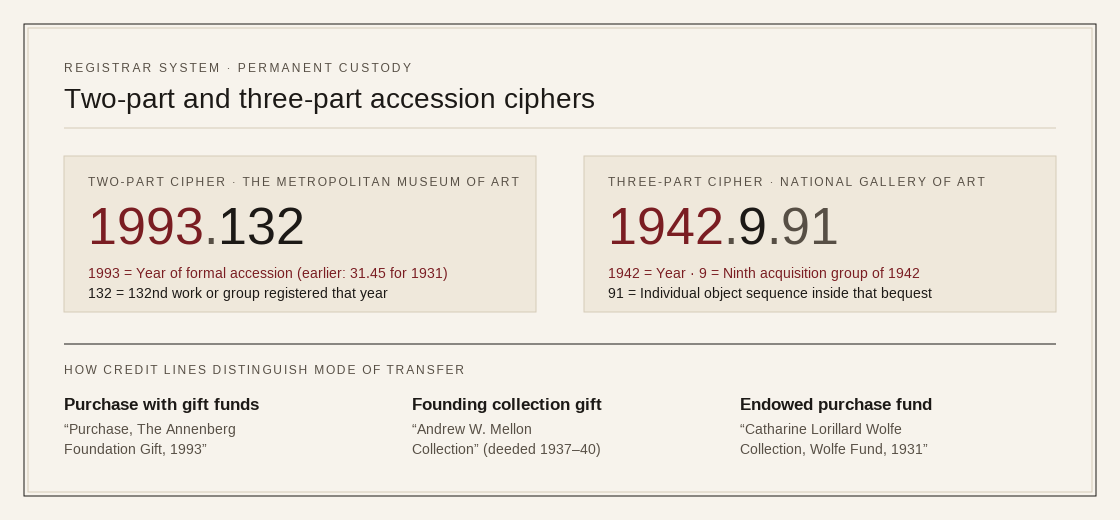
Although historic European princely collections sometimes preserve eighteenth-century inventory prefixes (Inv. at the Louvre or GG at the Kunsthistorisches Museum in Vienna), modern British and North American art museums rely almost universally on one of two numerical systems:
- The two-part chronological cipher (
Year.Sequence): Used for individual acquisitions at institutions such as The Metropolitan Museum of Art in New York. Before 1970, The Met abbreviated the century (31.45denotes the forty-fifth object or single-lot purchase registered in 1931); from 1970 onward, registrars wrote the four-digit calendar year in full (1993.132marks the 132nd registration of 1993). - The three-part trinomial cipher (
Year.Lot.Object): Standardised across the National Gallery of Art in Washington, the British Museum (Year,MonthDay.Object), and university collections handling multi-work gifts. Here the first number records the year of entry, the second identifies the acquisition batch (for example, the ninth deed of gift accepted by trustees that year), and the third identifies the individual painting, print or bronze inside that group, sometimes followed by.aand.bfor separable components such as a porcelain ewer and its cover.
Inside the conservation studio, registrars never paint an accession number directly onto raw canvas or porous stone. Instead, a reversible archival barrier coat of acrylic resin is brushed onto an inconspicuous structural edge on the stretcher bar or sculpture base, the cipher is lettered in carbon ink, and a clear topcoat seals it, ensuring the mark survives floods, relining or frame changes while remaining completely removable with mild solvent.
Reading two Fifth Avenue credit lines sixty-two years apart
If the accession number supplies the date and ledger slot, the museum credit line explains the financial architecture of the crossing without printing a dollar figure on the gallery wall. Two canonical French and Dutch canvases in our permanent library, both held by The Metropolitan Museum of Art, show how subtly credit wording distinguishes one acquisition structure from another.
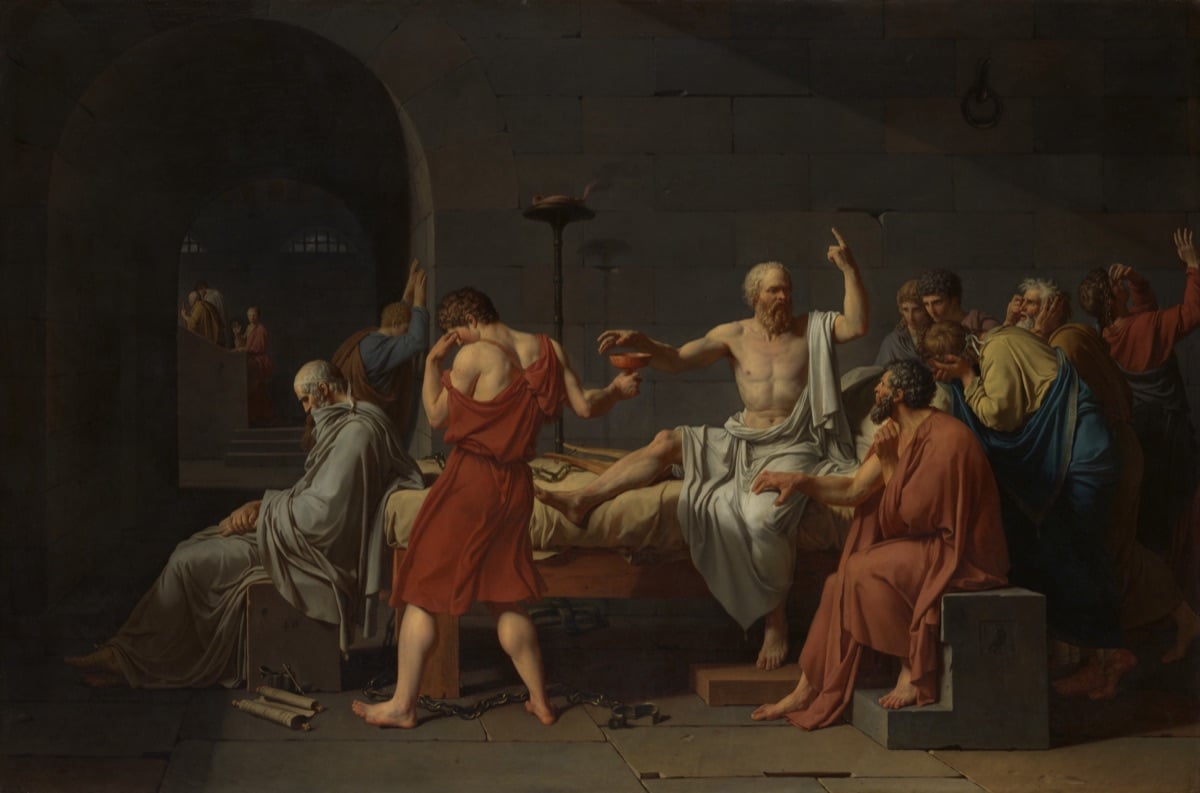
The Metropolitan Museum of Art · 1931
Jacques Louis David, 1787 · Image courtesy of The Metropolitan Museum of Art, New York · Public domain · Image source ↗
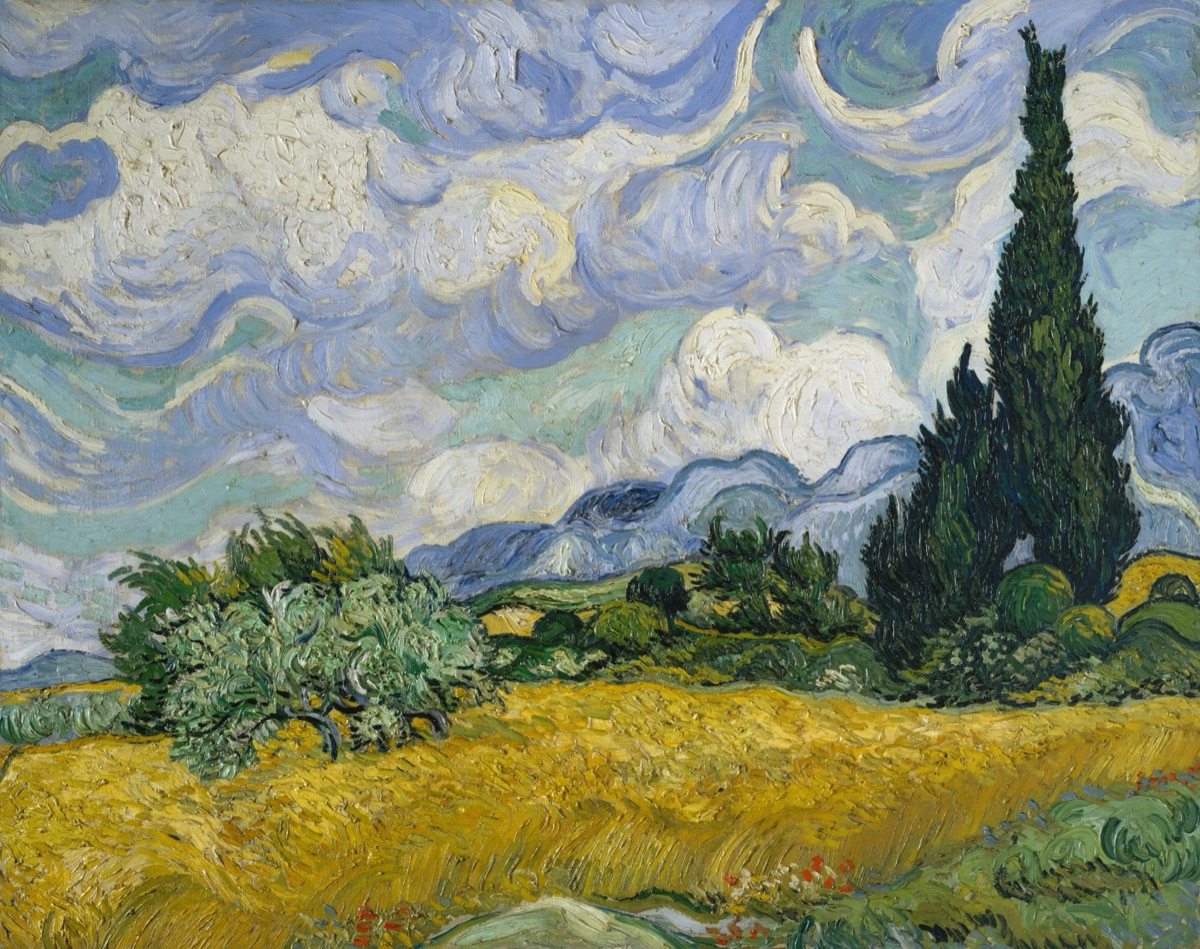
The Metropolitan Museum of Art · 1993
Vincent van Gogh, 1889 · Image courtesy of The Metropolitan Museum of Art, New York · Public domain · Image source ↗
Look first at Jacques Louis David’s The Death of Socrates (1787), measuring 129.5 × 196.2 cm. Its credit line reads: Catharine Lorillard Wolfe Collection, Wolfe Fund, 1931 (31.45). Catharine Lorillard Wolfe died in 1887, forty-four years before David’s painting reached Fifth Avenue. Alongside bequeathing her own nineteenth-century paintings to The Met, she endowed a permanent restricted acquisition fund exclusively for buying works of art. Whenever curators draw income from an endowed bequest decades or a century after the donor’s death, the credit line names the fund rather than a living patron, turning nineteenth-century philanthropy into twentieth- and twenty-first-century buying power in the saleroom or dealer market.
Compare that structure with Vincent van Gogh’s Wheat Field with Cypresses (73.2 × 93.4 cm), painted at Saint-Rémy in 1889 and featured on the cover of Issue No. 1. Its credit line reads: Purchase, The Annenberg Foundation Gift, 1993 (1993.132). The word Purchase at the front is exact. Walter and Leonore Annenberg did not own Wheat Field with Cypresses and donate the canvas itself (as they later bequeathed their own Impressionist collection in 2002); rather, the Annenberg Foundation provided the dedicated acquisition capital enabling the museum to buy the canvas out of European private hands in 1993.
From Bond Street ledger to public gallery: how private collections become founding gifts
Behind almost every three-part museum gift cipher lies an earlier commercial chapter in the dealer trade. Before American industrialists such as Andrew W. Mellon, Peter A. B. Widener, Samuel H. Kress and Henry Clay Frick transferred entire collections into public foundations, each painting had to be sourced singly through European and American dealers.
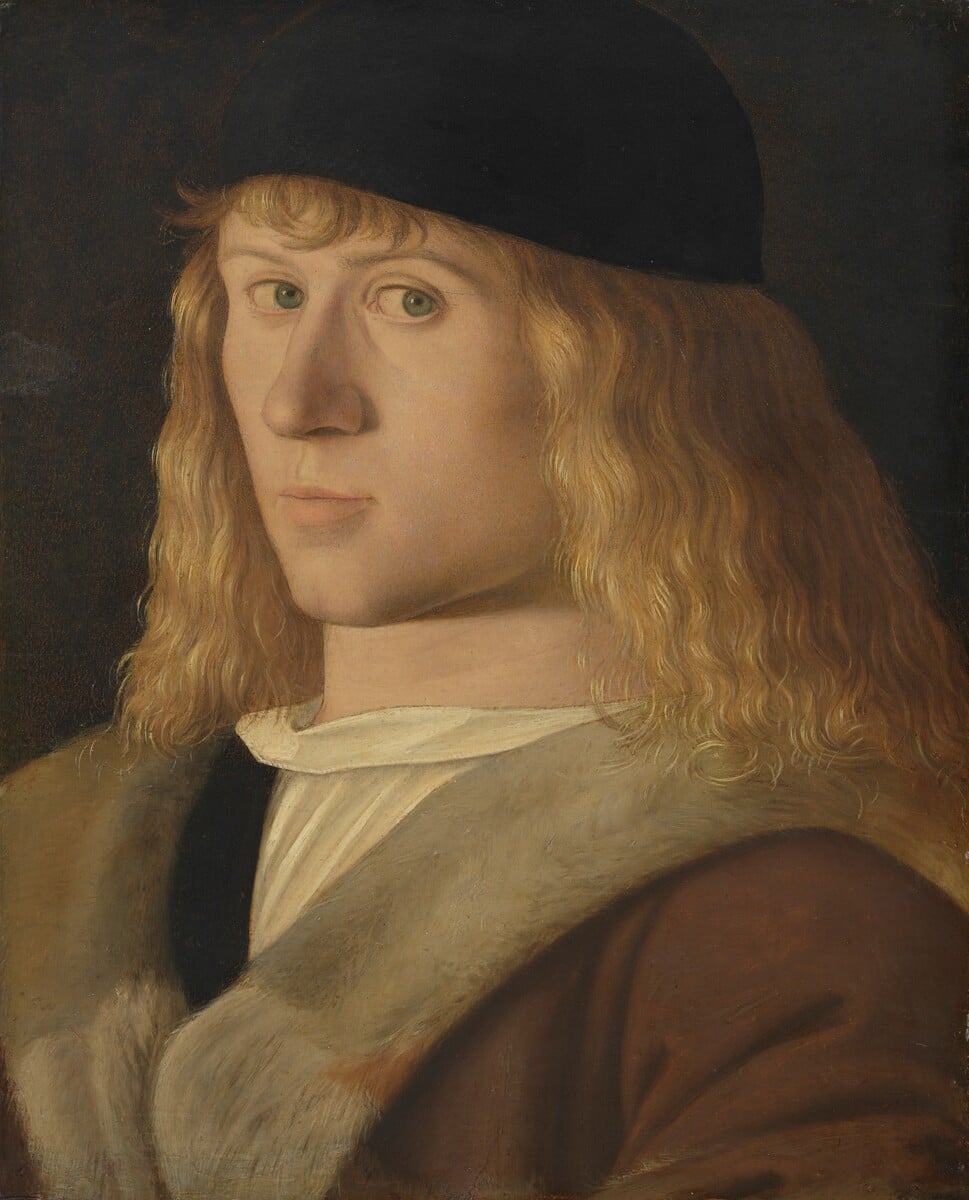
Gallery sale · United Kingdom
Venetian, 16th century
Sold by Thomas Agnew & Sons in London to Peter A. B. Widener in 1900; forty-two years later, Widener’s son Joseph presented the family collection to the National Gallery of Art in Washington.
Venetian, 16th century · Image courtesy of the National Gallery of Art, Washington · Public domain · Image source ↗ · Permanent record →
Follow the Venetian sixteenth-century Portrait of a Young Man in our painting archive. In 1900, Thomas Agnew & Sons in London acquired the portrait and sold it onward the same year to the Philadelphia collector Peter A. B. Widener, one year after the same Bond Street dealership bought Sir Henry Raeburn’s Colonel Francis James Scott at a London auction on 1 July 1899 and placed it with Marcus Trevelyan Martin. When Joseph E. Widener donated the Widener holdings to the newly opened National Gallery of Art in 1942, hundreds of individual dealer purchases made between 1890 and 1930 received sequential three-part 1942.9.* accession numbers in a single civic transfer. Separating the 1900 dealer sale from the 1942 museum gift lets a researcher see both halves of the biography clearly.
Deaccessioning: the rare door back into the saleroom
Does an accession number remove a work from commerce forever? Almost always, though not without regulated exceptions. Deaccessioning is the formal legal procedure by which a museum removes an accessioned object from its permanent register, whether to restitute a work spoliated between 1933 and 1945, repatriate cultural patrimony, transfer duplicate impressions between public institutions, or refine holdings to fund new acquisitions.
Professional governance codes make that door deliberately narrow. Under the standards enforced by the Association of Art Museum Directors (AAMD) and the American Alliance of Museums in North America, proceeds from any deaccessioned artwork may be used strictly for direct collection care or the purchase of replacement works of art, never to pay operating deficits, building maintenance or staff salaries. In the United Kingdom, national collections governed by statute (such as the National Gallery and Tate) operate under near-total statutory bars against disposal save for restitution or spoilt duplicates.
“Where an auction lot number marks a night of competition, an accession number records a generational promise of custody.”
Whenever a deaccessioned work does re-enter an evening sale (identifiable in the auction catalogue by an old museum cipher still stencilled on its stretcher and a footnote reading Sold to benefit the Acquisitions Fund), its former accession number travels with it as provenance evidence. Both crossings belong in a complete ledger of how art moves. Browse museum acquisitions alongside auction and gallery records across nineteen countries in the sales library, or trace geographical patterns across our nine city collections.
Records cited from the library
Every transaction discussed above keeps a permanent source-verified entry in the deployed.works register.
The Metropolitan Museum of Art
1931 · United States
Price unpublished
The Metropolitan Museum of Art
1993 · United States
Price unpublished
Thomas Agnew & Sons
1900 · United Kingdom
Price unpublished
Thomas Agnew & Sons
1899 · United Kingdom
Price unpublished
Further reading in the blog
Saleroom & fair mechanics · 24 November 2026 · 7 min read
Hammer price, buyer’s premium and the gallery asking price
Why two truthful reports of the same sale can print two different sums, and how auction fees, reserves and fair checklists govern what the public actually learns.
Provenance & cataloguing · 23 November 2026 · 7 min read
Art provenance and the catalogue raisonné: how a work’s history survives
How museum provenance punctuation, nineteenth-century dealer stock books and catalogues raisonnés establish where an object has been and which transfers remain unproved.